Tuesday, May 1, 2018

False Accusations of Witchcraft

When we arrived in Enga in late March, we heard a disturbing report that two women who live across the river from our house had been accused of practicing witchcraft and were then burned with hot iron rods. After asking around, we discovered that one of the women was killed, while the other was still alive.

Unfortunately, this was not the first time we had heard of such activity. For the past few years, reports of men accusing women of witchcraft and then burning them with hot iron rods has been on the rise. Such accusations usually arise when a person unexpectedly becomes sick or dies. Ignorant of the underlying medical causes, some Papua New Guineans seek out what is called a “glass man” (something like a witch doctor who claims to be able to use magic to discern who has caused the sickness or death). The “glass man” performs his “magic” and then accuses one or more people of taking the sick or dead person’s heart and eating it. In Enga, the accused are almost always women, and we have heard reports that the accused women are often divorced, which means that they have no husband to protect them.

While we have been praying about this problem for a while now, the fact that it happened in the neighboring tribe, just across the river from where we live, brought home the reality of just how terrible this practice is.

Jenny showing us the burn marks on her back

A few days after hearing these reports, I heard that Jenny (not her real name), the woman who is still alive, was in Wabag town. I was able to track her down and speak with her. As soon as I met her, I told her, “I know that you have done nothing wrong. My wife and I want to pray for you and help you, so please come to our house this afternoon.” She agreed, and later that day she came to our house. We prayed for her and then listened as she shared her story. With her permission, I took a video of her telling her story, which I am posting online for you to see. It is difficult to watch because of the terrible things that were done to her. But at the same time it is a powerful testimony of God rescuing her when all hope seemed to be lost.

Out of respect for the Jenny's privacy and safety, please do not repost the video online or share it. As you watch, please know that Jenny's young daughter is safe and sound. Also please be aware that she tells her story in typical Papua New Guinean fashion, which means that she repeats the story a couple of times, adding additional details each time. You can view the video at (https://vimeo.com/263589097). You will need a password to watch the video, so if you would like to watch the video, please send me an email to request the password. (Please note that I will not release the password to anyone living in Papua New Guinea because I want to protect Jenny's privacy.)

After praying with Jenny and listening to her story, we gave her some assistance and walked her back to her village. Although she did nothing wrong and there is absolutely no evidence that she has done anything wrong, most of the people in her tribe have decided that she is a witch or “poison woman.” As a result, they don’t want to have anything to do with her. Our hope was that, by walking her back to her village, the people in her tribe would know that we do not think that she is a witch. As we arrived in her village, I made a short speech in the market area. I told the people that Jenny was not a witch and that she had done nothing wrong. I then told the people that they needed to have compassion on her and help her since she was still too weak and injured to work her garden.

In light of what has happened to Jenny, I have decided to begin preaching in various churches in Enga to encourage the Christians to stand against this terrible practice of falsely accusing women of witchcraft and then burning and torturing them. Sadly, many Christians are afraid that these women truly are practicing witchcraft. They are also afraid that, if they stand up for these women, they too will be accused of witchcraft. It is eerily similar to the Salem Witch Trials that happened in America in the late 17th century.

Please pray for Jenny as she recovers from the terrible ordeal she has had to endure, and please pray for her ongoing safety as she is still living in her village, where many think that she is a witch. Please also pray for the Christians of Enga that they will know that such accusations are false and that they will firmly stand up in opposition to the torture of innocent women. Please also pray for us as we do all we can to raise awareness and encourage people to oppose this terrible practice. Thankfully, the government of Papua New Guinea is opposed to this practice and is taking action to curtail such killings and torture.

Sunday, April 1, 2018

Inspired Exhibit

At the end of February I received an email from David Addington, a former boss of mine and dear friend who is also an ardent supporter of Bible translation. He informed me that he would be coming to Port Moresby in March as part of his work with an organization called Inspired Exhibit. With a stunning display of over 100 rare biblical manuscripts and collateral items, the exhibit chronicles the remarkable story of how the very words of God, written with His own finger on tablets at Mt. Sinai—were carefully copied, preserved, and through great toil and sacrifice have come to our generation, languages, and the tablets we now hold in our hands. He invited me to come to Port Moresby to be a part of the initial meetings to bring this exhibit to Papua New Guinea. So I flew down to Port Moresby to be a part of the meetings and met up with David and Dr. Scott Carroll, an expert in ancient documents who has been involved in putting together some of the largest collections of Biblical manuscripts in the world.

Dr. Scott Carroll (left) and David Addington (center) presenting to government officials at the National Parliament. (You don't see me because I am taking the picture.)
It is not uncommon for Papua New Guineans to assume that the Bible was originally written in English and that Christianity originated in English speaking cultures. Similarly, Papua New Guineans often have questions as to why they should trust the Bible. In fact, during a meeting at the Parliament building, the Clerk of Parliament shared that his own children had recently been questioning the reliability of the Bible. But the government officials were quite impressed when Dr. Carroll unrolled a three hundred year old Torah scroll written on calfskin and showed them the ten commandments written in Hebrew. And everyone was in agreement that when Papua New Guineans see even older manuscripts of the Bible and learn about how the biblical text has been transmitted through time, they will gain appreciation for the fact that the Bible is not an English book that originated in English speaking cultures, but that God is a God of all people regardless of a person's ethnic background or language. Similarly, they will see that the Bible has been faithfully preserved throughout history and is a trustworthy and reliable record of God's message for humanity.

Dr. Carroll pointing out the Ten Commandments written on a three hundred year old Torah scroll.
Not only will the Inspired Exhibit teach people about the history of the Bible and its transmission over time, it will also be an opportunity for Papua New Guineans to learn about Bible translation into their own languages today. The exhibit will include a station for people to listen to the Bible in their own languages and download Scripture text and audio in their own languages. Thus, Papua New Guineans from the more than eight hundred language groups in the country will be encouraged to become an ongoing to part of the preservation and transmission of Scripture.

Connecting with church leaders and government officials in Port Moresby.
The exhibit is tentatively scheduled for sometime between March and June 2019 in Port Moresby, Lae, and Mt. Hagen, the latter of which is just a two-hour drive from Enga. Please pray for all the many details to come together for this exhibit to take place, which will be a great boon not only to Bible translation efforts but to the Christian faith here in Papua New Guinea.

Thursday, March 1, 2018

The Gospel of John

A couple of weeks ago we finished our consultant check of the Gospel of John. This was the first book that we have checked since moving to a more literal translation approach. It was also the first check in which we were able to include a woman in the checking process. The results were very promising. Both of the people who came to check the work consistently understood the literal translation, including the underlying spiritual meanings. Lovey Reto, the woman who joined us, was particularly helpful in providing feedback into the translation. We hope that we may be able to involve her in checking books with groups of women in the village since the majority of church members in Enga are women. Please pray that Lovey would be available to help us and that we would get helpful feedback from groups of women to counterbalance the mostly male input that we get from the translation team.

Having a laugh while checking the Gospel of John
The Beatitudes
In September, I explained in detail our decision to shift to a more literal translation style by examining Matthew 5:3, which says, "Blessed are the poor in spirit, for theirs in the Kingdom of Heaven." The Enga translation at that time was more of a dynamic translation and read, "God blesses the people who are poor in spirit and want him to help them. Those blessed ones will be in his kingdom." Not satisfied with the approach we had taken to this verse, we decided that we were going to attempt a more literal translation. This is what we have come up with: "God blesses the people who are like poor. Does poor here mean “humble”?—that’s how we translated our literal KK. The Kingdom of Heaven belongs to those blessed ones." This is a much more literal translation of the text, but it still sounds very good and poetic in Enga. You will notice that we had to make a couple of minor adjustments to conform to Enga ways of speaking, but, for the most part, it captures the literal meaning of the text in a way that sounds good in Enga. Please pray that God would continue to help us find the balance between translating literally and translating in a way that sounds good and makes sense in Enga.

Future Plans
Later this month we head back out to Enga for nine weeks to finish revising the last half of Matthew to bring it into alignment with our more literal approach to translation. We will also make minor adjustments to the Gospel of John that we discovered in the consultant checking process. Finally, we will review my advisor notes for the book of Acts. After we have reviewed those notes, I will back-translate Acts in preparation for a consultant check of that book. Translation work is moving along very well. The team, working in three groups of two, is nearly finished drafting Romans, 1 Corinthians, and 2 Corinthians. After that, only the book of Ephesians will be left to draft, and then the New Testament drafting process will be complete. There is still much work to be done in checking and correcting these drafts, but finishing the New Testament drafting process is a milestone that we look forward to with much anticipation and excitement! Please pray that nothing would hinder our work. Thank you so much for your ongoing prayer and support which enables us to complete this work.

Thursday, February 1, 2018

Engan Proverbs

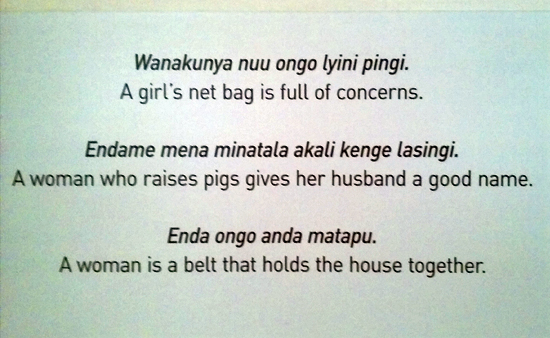
The first time that I visited the Enga Cultural Center, I was fascinated as I read some of the traditional Engan proverbs on display. The short, pithy sayings communicate truths not only about traditional life in Enga, but also about life in general. Let me give you some examples. The proverb, “With words alone nothing is done,” communicates the reality that “talk is cheap,” and action is required to actually get anything accomplished. The proverb, “When an opossum is sitting in the tree, don’t say that you are going to eat it,” is similar to our saying, “Don’t count your chickens before they hatch,” and communicates that it is not wise to make plans that are based on something that hasn’t actually happened yet. The proverb, “Pigs are bound with rope; men are bound with words,” reminds me of the saying, “The pen is mightier than the sword,” and communicates that words can be more powerful than brute strength when it comes to dealing with people. 
 
Some Engan proverbs on display at the Enga Cultural Center
While I am always interested to ponder these proverbs whenever I am in the cultural center, there are two proverbs that I am drawn to more than all the others. The first is, “The small tongue kindles a big fire.” What is fascinating about this proverb is its similarity to James 3:5, which says, “So also the tongue is a small member, yet it boasts of great things. How great a forest is set ablaze by such a small fire!” The second proverb is equally fascinating; it says, “What you do for someone else; that also he does to you.” This sounds like a paraphrase of the golden rule in Matthew 7:12, which states, “So whatever you wish that others would do to you, do also to them.” It seems that even before missionaries ever arrived in Enga, God was already revealing His truth to the people. And just as Jesus came to bring fulfillment to the Law and the Prophets, my prayer is that the people of Enga will see that that traditional wisdom and sayings that God gave them in the past also find their fulfillment in Jesus and the good news that the Kingdom of God is at hand.

More Engan Proverbs
Since I have whet your appetite for traditional Engan proverbs, let me share a few more with you. Like many Enga proverbs, the saying, “When you see the sun, don’t put out the fire,” has a surface-level meaning as well as a hidden meaning. The surface-level meaning is this: just because the sun has risen in the morning doesn’t mean that you won’t still need a fire to cook with and to keep warm by at night. The hidden meaning is similar to our expression, “The grass is always greener on the other side,” and basically means, “When you see something that appears better than what you have, don’t underestimate what you have and leave it for what appears to be better.”

Another proverb states, “Once you have split a taro, you cannot put it back together.” Often when people share food like a taro, they do so by splitting it in half and handing a portion to someone else. But once you have split the taro apart, you obviously cannot put it back together. The hidden meaning of this proverb speaks to relationships and suggests that once a relationship is broken, it cannot be mended. Sharing food is indicative of good relationships, and so this proverb is particularly apropos.

Another proverb communicates a similar message; it states, “You can put an ax back, but you can’t put words back.” The idea is that a person can always return an ax to his belt, where he normally keeps it, but once he has spoken words, he cannot take the words and put them back in his mouth. This proverb reminds people of the importance of thinking before they speak.

The proverb, “Don’t try to knock down a hawk while looking at its shadow,” communicates the necessity of looking at the heart of a matter and not just the surface. The proverb, “An earthworm that crawls around is destined to die,” indicates that a person should not wander around aimlessly. And the proverb, “A sprouting bean seed will always climb a bean stick,” is a hidden way to say, “If you incite trouble, it will always stay with you.” 

An earthworm that crawls around is destined to die
God created the entire world as an expression of his personality, and as we study creation we learn about God’s character. As Romans 1:20 says, “For his invisible attributes, namely, his eternal power and divine nature, have been clearly perceived, ever since the creation of the world.” How thankful we are that God has prepared the Enga people in advance to receive the one who is the exact imprint of God’s very nature!

Monday, January 1, 2018

Lead Us Not Into Mistranslation

Recently Pope Francis suggested on Italian television that the English translation of the Lord’s Prayer, “Lead us not into temptation” (Mat 6:13; Luk 11:4) “is not a good translation because it speaks of a God who induces temptation.” He went on to say that, “It is Satan who leads us into temptation; that is his department.” As a result, Pope Francis suggested changing the English translation of the Lord’s Prayer to “Do not let us fall into temptation.”

The problem with the Pope’s suggestion is that the Greek text of Matthew 6:13 and Luke 11:4 is quite clear, and the traditional rendering “lead us not into temptation” is a faithful and literal translation of the text. “Lead us not into temptation” is exactly what the Greek text says. It is a request to God on the part of the one praying that God not lead us into temptation. Interestingly, the Greek word translated as ‘temptation’ can also be translated as ‘test’ or ‘trial’.


Pope Francis’s comments highlight a common question that we Bible translators ask ourselves—do we translate what the text actually says, or do we translate what we think the text should say? The temptation is great to translate what we think the text should say rather than translating what the text actually says. But there is great danger in doing so, because we begin to insert our own ideas and interpretations into the text, obscuring what the text actually says and promoting our own particular brand of theology. Now, it is impossible to avoid all interpretation in the process of translation, but interpretation should generally be avoided if at all possible.

Incidentally, a couple of years ago before Pope Francis made his comments about the Lord’s Prayer, someone suggested to me that we should do the exact same thing in Enga. The Enga translation of the Lord’s Prayer says, “Do not bring us and go into the tempations to do bad.” That is a very literal translation that captures well the meaning of the Greek text. But someone suggested that we should change our translation to “Don’t abandon us, telling us to go into the temptations to do bad.” The person who made this suggestion, like Pope Francis, wished to defend God’s character as someone who does not tempt to sin. However, after considering the suggested translation, we decided to stick with our more literal translation.

The problem is that we often do not have the perspective that we need to see the bigger picture of the biblical narrative and the nuances of the text. Pope Francis is correct that God himself does not tempt us to sin, and that temptation is the devil’s department. However, the Lord’s Prayer does not suggest that God himself tempts us. Rather it suggests that God can lead us into temptation, just like the Spirit led Jesus into the wilderness to be tempted by the devil. The Spirit did not do the tempting, He just did the leading. God can lead us into a time of temptation, but He Himself doesn’t tempt us.

The point is that we should not seek out opportunities to be tempted. We should avoid temptation and actively ask God not to lead us into temptation. Yet we must also recognize that God, in His sovereignty, may at times choose to lead into temptation, just as the Holy Spirit led Jesus into the wilderness to be tempted.

No, the Lord’s Prayer does not need to be corrected. And that is the lesson we Bible translators must learn: When the Scripture seems like it needs to be corrected, it is a good indicator that it is actually our understanding of God that needs to be corrected.

Friday, December 1, 2017

Newbreak Missions Team 2

In September, we were privileged to host a team of five from Newbreak Church. In November, we were privileged to host another team of five from the same church. It was a busy week of travel, open air preaching, and showing the Enga Jesus Film.

The Second Newbreak Missions Team
The Wild West
After the team got settled in, we took a trip to what is called The Wild West, which is the western part of Enga Province. Upon our arrival in the village of Mulitaka, we discovered that the back, right tire of my truck had a puncture from a piece of metal and was slowly deflating. Fortunately, there was a tire service in the village, so Pastor Duane from Newbreak Church and I went to get the tire repaired. In the two hours while we waited for the repairs, a crowd of about two hundred people gathered around us in a perfect semi-circle to meet us and listen to "the white man speaking in Enga." We had good interactions with the crowd and invited them all to watch the Enga Jesus Film that night at the local high school, just a short walk from the tire service. About 6:45 PM I got the film started and then asked Van Hooper from Newbreak Church to look after the equipment while I went to eat dinner in the house where we all were staying. Some time afterward, Van came running up to the house a little out of sorts, saying that there were men with machetes who were causing a disturbance. I went down to see what the problem was, and it turns out that so many people showed up to see the film that there was no longer space for anybody else in the room where we were showing it. The men with bush knives were demanding that we move the projector and screen outside so that everyone could see the film. I told them that we would show the film a second time once the first showing ended, and everyone was happy with that. It is a good problem when people are demanding that space be made so that they too can see the Jesus Film in Enga!

The venue where we showed the Jesus Film in Mulitaka
The next morning we traveled to the check point at a village called Maipya, which is the last village where the people speak Enga rather than Ipili (the next language bordering Enga). We set up a small speaker in the market area. As people gathered around, I introduced the team members from Newbreak Church who shared greetings and short testimonies. I then shared my own testimony and the gospel message in the Enga language and gave people an opportunity to repent from their sin and put their faith in Jesus. Afterwards people were invited to buy Audibibles and memory cards with the Enga recordings of Matthew, Mark, Luke, and the Abraham story from Genesis. We did the same in the villages of Tumandan and Mulitaka. By the end of the day we had preached the gospel to over 500 people and sold a handful of Audibibles and memory cards. It is difficult to gauge response to the gospel messages that were preached, but we trust that some seeds were planted in good soil and will bear fruit.
Preaching the gospel in the village of Maipya
Kompiam
After returning from The Wild West, we spent a day at our home in Immi village, where the team helped us with many home improvement projects, which was a great blessing. The next morning we headed out to Kompiam, which is quite literally the end of the road in the northeastern part of Enga Province. A local pastor in Kompiam had set up a grand stand in the main field outside of the government station, and we shared greetings, testimonies, and the gospel message just as we had in The Wild West. The people in Kompiam were particularly receptive, and one older man shared in tears about how much it meant to him that I was speaking in Enga and translating God's Word so that they could understand it in their own language. Afterwards many people bought Audibibles and memory cards containing the Enga Bible recordings. At night we showed the Enga Jesus Film in a local church, and despite a torrential downpour, sixty people showed up to see the film.

 
People gathering to buy Enga Audibibles in Kompiam
Thank You
We wish to express our appreciation to Dan Lamborn, Duane Flewelling, Van Hooper, Mike Kuypers, and Susana Leung for taking time out of their busy schedules to minister to us and the people of Enga. Along with your help and the help of the first team from Newbreak Church, we preached the gospel to over one thousand people and showed the Enga Jesus film to about six hundred people. We may not know the fruit of our labors until we get to heaven, but let's pray that God will move in the lives of those who heard the good news and bring them to repentance and faith in our Lord and Savior Jesus Christ.

Thursday, November 30, 2017

Review of the American Literary Version of the Bible

The American Literary Version (ALV) is an update to the American Standard Version (ASV) that was published in 2016 as a part of the Bibliotheca multi-volume set of the Bible. Bibliotheca broke new ground by producing a Bible without any chapter numbers, verse numbers, section headings, or footnotes. It is stunningly beautiful in its radical simplicity. Many other reviewers have focused on the physical beauty of the Bibliotheca Bible, and so I will focus on reviewing the American Literary Version translation, which was produced by Bibliotheca.

What began as a light revision of the ASV (i.e. updating thee and thou) turned into a more in-depth revision as the funding for Bibliotheca increased. The resulting translation is more literal than the ASV, while still maintaining a relatively high degree of readability for those who are well-versed in the Scriptures and who don’t mind looking up an occasional word in the dictionary.

While many modern translations such as the NASB, NKJV, and ESV claim a high degree of literalness, they are not as literal as one might expect. Often these translations make changes to the text to increase the readability for modern readers. However, while the translation becomes more readable, the literal meaning of the actual Greek or Hebrew source is obscured. The ALV more consistently provides a truly literal rendering of the Greek and Hebrew source text.

Consider, for example, 2 Peter 2:4. The NASB reads, “For if God did not spare angels when they sinned, but cast them into hell…” The Greek word translated as cast into hell is ταρταρόω, which is a verb that means ‘consign to Tartarus’. In Greek thought, Tartarus is a place of punishment and torment located below Hades. Tartarus is different from the word γέεννα, which is usually translated as ‘hell’. The ESV and NKJV follow the NASB in translating ταρταρόω with the word ‘hell’ instead of ‘Tartarus’. The ALV is more literal in translating the underlying Greek of 2 Peter 2:4. It reads, “For if God did not spare angels when they sinned, but cast them down to Tartarus…” In addition to rendering ταρταρόω more literally, the ALV also translates γέεννα as ‘Gehenna’ rather than ‘hell’, which preserves the imagery of the Valley of Hinnom, the city dump of Jerusalem where trash was burned.

Philippians 1:27 is another example in which the ALV is more literal than even the most literal of modern translations. The NASB and NKJV translate Philippians 1:27 as “Only let your conduct be worthy of the gospel of Christ…” The ESV translates it as, “Only let your manner of life be worthy of the gospel of Christ…” The underlying Greek word for the bolded text is πολιτεύομαι, which literally means ‘live as a citizen’. Philippians is written to Christians living in a Roman colony, where there are many retired soldiers. The people of Philippi were known for their patriotic nationalism. In such an environment, the Christians in Philippi may have been tempted to see their citizenship as being in Rome rather than in heaven. But Philippians 1:27 specifically encourages the Philippians to view their citizenship in terms of the gospel of Jesus Christ, which is the gospel of the Kingdom of God. But this talk of citizenship is obscured in the NASB, NKJV, and ESV. The ALV, on the other hand, translates Philippians 1:27 as, “Only behave worthily as citizens of the good tidings of the Christ…” This more literal translation highlights Paul’s exhortation to the Philippians to live as citizens of God’s Kingdom rather than as citizens of Rome.

Another example of how the ALV exceeds other translations in literalness is Matthew 5:3. The NASB, NKJV, and ESV all translate Matthew 5:3 as, “Blessed are the poor in spirit, for theirs is the kingdom of heaven.” The ALV translates it as, “Blessed are the poor in spirit, for theirs is the kingdom of the heavens.” The underlying Greek word is plural and so the ALV renders the source text more literally. It may sound awkward at first to say “the kingdom of the heavens,” but that is only because we are used to hearing “the kingdom of heaven.”  The plural form ‘heavens’ is actually quite natural in English. For example, we don’t have any problem with Genesis 1:1, which states, “In the beginning God created the heavens and the earth.” Neither are we disturbed by Psalm 19:1, which says, “The heavens declare the glory of God.”

In its quest for preserving the literary nature of the biblical texts, the ALV preserves idioms that modern translations alter. For example, the NASB and ESV translate Genesis 29:1 as, “Then Jacob went on his journey…” (The NKJV is similar.) However, the ALV preserves the Hebrew idiom and translates it as, “And Jacob lifted up his feet…” In another example, the NASB translates 1 Samuel 25:22 as, “May God do so to the enemies of David, and more also, if by morning I leave as much as one male of any who belong to him.” The ESV and NKJV similarly employ the words one male. However, the actual Hebrew text does not say one male. It says, “one who pisses against the wall,” which is a rich idiom denoting a male. The ALV preserves this idiom and the strong imagery it evokes.

In all of these cases, the ALV is not only more literal than the NASB, NKJV, and ESV, it is more literal than the ASV as well. In at least one instance, however, the decision of the ALV translators to retain the ASV rendering results in a translation that is less literal than the NASB, NKJV, and ESV. That is the translation of the word ἀνομία. The NASB, NKJV, and ESV all translate this word with its literal meaning 'lawlessness'. The ALV, however, retains the ASV rendering of 'iniquity', which means 'immoral or grossly unfair behavior'. While immoral behavior is often contrary to the law, such is not always the case, and so 'lawlessness' is a more literal translation.

Regarding textual basis, the ALV translates from the Masoretic text in the Old Testament and the critical text in the New Testament. In the Old Testament, the ALV is less likely to follow the Septuagint (and other ancient versions) than the ASV, NASB, NKJV, or ESV. For example, in Exodus 8:23, the ASV, NASB, NKJV, and ESV all follow the Septuagint text with translations like, “I will make a distinction” or “I will put a division.” The ALV follows the Hebrew text and renders Exodus 8:23 as “I will set a ransom.” There is good reason to believe that the Septuagint preserves the original reading in this case, but the ALV seeks to be a faithful translation of the Masoretic text.

Regarding style, the ALV retains much of the archaic vocabulary of the ASV. Personally, I don’t mind this as, in my opinion, it adds to the literary beauty of the translation. It also constantly reminds me that the Bible was not written in modern English. I just keep my dictionary handy so that I can look up words that are unfamiliar. Those who are accustomed to the King James Version probably won’t have much trouble. The ALV does, however, update the words thee, thou, thy, and thine to their modern equivalents and also drops archaic verb endings like -eth and -est. Similarly shalt and wilt are rendered as shall and will.

There is, however, one update introduced by the ALV that does take some getting used to. The Hebrew interjection נָא is used to indicate earnestness and humility and is usually translated in the ASV with the words ‘now’ or ‘I pray thee/you’. For example, in Genesis 18:3-4 the ASV reads,

My lord, if now I have found favor in thy sight, pass not away, I pray thee, from thy servant: let now a little water be fetched, and wash your feet, and rest yourselves under the tree:

The ALV prefers to translate נָא with the word ‘pray’ in every occurrence. (The only time I have ever heard the word ‘pray’ used in this way is in the expression, “Pray tell!”) This often results in awkward English phrasing as seen, for example, in the ALV rendering of Genesis 18:3-4,

My lord, if, pray, I have found favor in your eyes, do not pass away, pray, from your servant. Pray, let a little water be fetched, and wash your feet, and rest under the tree.

This does not make for smooth flowing English. Nevertheless, after spending some time with the ALV, I have gotten used to this idiosyncrasy. In fact, it makes me take notice of speech patterns that I might otherwise have missed. For example, in the story of the ten plagues in Exodus, I noticed that Pharaoh eventually shows more humility in his requests to Moses as indicated by the word ‘pray’. In Exodus 10:11, Pharaoh says, “Go, pray, you who are men.” And in Exodus 10:17, Pharaoh says, “And now forgive, pray, my sin.” Without this somewhat awkward occurrence of the word ‘pray’, I don’t think I would have taken note of this change in Pharaoh's tone. Nevertheless, I think I prefer the ASV’s use of ‘I pray you’ and ‘now’ for translating the Hebrew interjection נָא.

One final note of interest is the rendering of the proper name of God, known as the Tetragrammaton. The proper name of God consists of the four Hebrew letters יהוה roughly equivalent to YHWH. We don’t know for sure how this name was pronounced because the associated vowels are the vowels for the word adonai and not YHWH. Most scholars, however, believe that the name is pronounced Yahweh. The Tetragrammaton has traditionally been rendered in English as ‘the Lord’. The ASV, however, sought a more direct translation and rendered the name as ‘Jehovah’, combining the vowels for adonai with the consonants for YHWH. The ALV simply renders the Tetragrammaton as YHWH. While it might seem that a name with no vowels and all capital letters would be a stumbling block to reading, I find that my mind naturally reads YHWH as ‘Yahweh’, and so it is not an issue for me.

In conclusion, the ALV is the most literal modern translation of the Bible available today. And despite its literal renderings, it has a relatively high degree of readability. It is certainly much easier to read than Young’s Literal Translation, from which it draws some of its translation choices. The awkward use of the word ‘pray’ does detract a bit from readability, but one quickly gets used to it and finds that it becomes less of a distraction over time. I highly recommend the American Literary Version to anyone who has a relatively high level of biblical literacy and who wants to know what the underlying Greek and Hebrew text actually says. And for those who read the Apocrypha or Deuterocanonical books of the Bible, you will be interested to know that Bibliotheca makes them available as a separate volume in the ALV translation.

Regarding the format, I find that reading the Bible without chapter and verse divisions, footnotes, or section headings is incredibly refreshing. The beautiful layout of the American Literary Version in the Bibliotheca Bible is unparalleled by any other Bible I know of. I can't put it down!

I will leave you with some sample passages from the American Literary Version so that you can get a feel for the translation.

The Beatitudes
Blessed are the poor in spirit,
for theirs is the kingdom of the heavens.
Blessed are those who mourn,
for they shall be comforted.
Blessed are the meek,
for they shall inherit the earth.
Blessed are those who hunger and thirst after righteousness,
for they shall be filled.
Blessed are the merciful,
for they shall obtain mercy.
Blessed are the pure in heart,
for they shall see God.
Blessed are the peacemakers,
for they shall be called sons of God.
Blessed are those who have been persecuted for the sake
     of righteousness,
for theirs is the kingdom of the heavens.

The Lord’s Prayer
Our Father in the heavens,
your name be hallowed,
your kingdom come,
your will be done,
as in heaven, so on earth.
Give us this day our daily bread;
and forgive us our debts,
as we also have forgiven our debtors.
And bring us not into temptation,
but deliver us from the evil one.

Psalm 23
YHWH is my shepherd;
I shall not want.
He makes me lie down in green pastures;
he leads me beside still waters.
He restores my soul.
He guides me in the paths or righteousness
for his name’s sake.
Yea, though I walk through the valley of the shadow of death,
I will fear no evil,
for you are with me.
Your rod and your staff,
they comfort me.
You prepare a table before me
in the presence of my foes.
You have anointed my head with oil;
my cup runs over.
Surely goodness and lovingkindness shall follow me
all the days of my life,
and I shall dwell in the house of YHWH
for length of days.

The Gospel of John Prologue
In the beginning was the Word,
and the Word was with God,
and the Word was God.
This one was in the beginning with God.
All things were made through him,
and without him was nothing made that has been made.
In him was life,
and the life was the light of men.
And the light shines in the darkness,
and the darkness did not apprehend it.

There came a man,
sent from God,
whose name was John.
This one came for witness,
that he might bear witness of the light,
that all might believe through him.
That one was not the light,
but came that he might bear witness of the light.

There was the true light,
which lights every man,
coming into the world.
In the world he was,
and the world through him was made,
and the world did not know him.

To his own he came,
and those who were his own did not receive him.
But as many as received him,
to them he gave the right to become children of God,
to those who believe on his name,
who were born not of blood,
nor of the will of the flesh,
nor of the will of man,
but of God.
And the Word became flesh,
and tabernacled among us,
and we beheld his glory,
glory as of the only begotten from the Father,
full of grace and truth.

John bore witness of him and cried out, saying,
“This was he of whom I said,
‘He who comes after me has become before me,
for he was before me.’”
For of his fullness we all received,
and grace for grace.
For the law was given through Moses;
grace and truth came through Jesus Christ.
No man has seen God at any time;
the only begotten Son,
who is in the bosom of the Father,
he has declared him.

Romans 8:31-39
What then shall we say to these things? If God is for us, who is against us? He who did not spare his own Son but delivered him up for us all, how shall he not also with him freely give us all things? Who shall lay anything to the charge of God’s elect? It is God who justifies. Who is the one who condemns? Is is Christ Jesus who died, yea rather, who was raised from the dead, who is at the right hand of God, who also makes intercession for us. Who shall separate us from the love of the Christ? Shall tribulation or anguish or persecution or famine or nakedness or peril or sword? Even as it is written,

     “For your sake we are killed all the day long;
     we were accounted as sheep for the slaughter.”

Nay, in all these things we are more than conquerors through him who loved us. For I am persuaded that neither death, nor life, nor angels, nor principalities, nor things present, nor things to come, nor powers, nor height, nor depth, nor any other creature, shall be able to separate us from the love of God, which is in Christ Jesus our Lord.