Video
A detailed write-up of our time in the village is below, but we have included two videos for you to watch. The first is called Segar Village Tour. It gives you a look at our day-to-day life in the village. The second is called POC Highlights and gives you a glimpse of our entire 14-week training, including our time in the village.
First Day
We arrived at the village of Segar just after lunchtime on Friday, March 23. After we finished putting all of our boxes upstairs into the house, school let out. Before we knew it, we had more than 50 school children swarming our front yard to come look at the 'white people'. It was a bit overwhelming. Before we knew it, Jacob was up on the balcony of our house looking down on all the kids and putting on a little show and making them all laugh. Later when the father of our host family came home, he asked us if we wanted to go down to the creek to bathe. We told him we did, figuring that it would be a good chance to see where the bathing area was. We walked across the road and started heading down the mountain toward the creek. As soon as we started walking, it started pouring down rain. Now we had just recently finished a three-day hike where we had walked up and down steep muddy slopes for eight hours a day. We felt ready to handle a short hike to the creek. Adam was carrying Asher as we went. But within his first ten steps, Adam slipped so hard on the wet ground that he fell on his back and dropped Asher at the same time. So we gave Asher to a boy about ten years old to carry for us. He carried Asher with no problems whatsoever and we walked the 15 minutes to the creek in the pouring rain. We bathed quickly and came back up the mountain. Upon returning to the village, we resisted the temptation to stay inside the house unpacking all of our things and instead we stayed downstairs and talked with our new friends in the village. Martha then made dinner and we went upstairs right after dark and had a good night's sleep.
Daily Routine
Each morning when we woke up we would gather everything we needed to make breakfast and put it in a large red bin and carry it all downstairs. Typical breakfasts were oatmeal, cereal, and eggs and spam. We usually heated water the night before and put it in a thermos so we could make coffee for Martha and Milo (sort of like hot chocolate) for Adam right when we woke up. After breakfast, we tried to do a short devotional together. Then Martha and Jacob would do school while Adam would talk with all of the visitors that usually came to see us. It was rare to have a morning without visitors around most of the time. They really enjoyed looking at our pictures from America and hearing stories about life there. Many asked me to tell them about what happened on 9/11, and we were surprised to find out that most of the people had never heard of Los Angeles. We were also surprised when people kept asking asking whether Jacob and Asher were male or female (a common question in Papua New Guinea because males and females both have short, black, curly hair). Other things we did in the morning was take the ashes from the previous day down to the liklik haus (outhouse) and dump them in the hole in the ground to help ensure the aroma didn't become too unpleasant. We also would turn our eggs every morning to help preserve them. Martha would also typically go down to the creek to wash the clothes and bathe (the two activities are done one after the other to avoid two trips down to the creek). Adam and the kids typically bathed up at the house in a tub of water because Adam would itch terribly if he bathed in the creek water, and the kids never wanted to go down to the creek to bathe. Needless to say the the difficulty of obtaining water and bathing in a small tub made bathing a rare commodity in our household. Around lunchtime we would start preparing lunch, often with an audience. We tried to keep lunch fairly simple like Ramen noodles or peanut butter and crackers. But we would also make homemade bread once a week and homemade tortillas once a week. Any meals that needed to be cooked were cooked over an open fire. A couple of times a week Adam would chop firewood and go down to the spring, fill up a 20 liter container of water, put it in a backpack, and haul it back up the hill. Of course, when it rained we could just fill up buckets with rain water, which saved Adam from having to go down to the spring. We began to really appreciate and welcome rain! After lunch, we would try to get Asher to nap, which was difficult to do with all of the people that were always hanging around under our house and all the kids from the village making noise. In the afternoon we would work on the assignments that we had been given to complete or we would just talk with everyone who had come to see us. Around five o'clock we started getting dinner ready. Our main staples were pasta, rice, and canned pork (like Spam). But we also had the occasional treat like tacos with ground beef, tomato, and avocado or fried cook bananas (a less sweet banana used for cooking). For dessert, we made instant custard once a week, and Adam even made fudge over an open fire on four different occasions. After dinner, we would clean all of our dishes, haul everything back upstairs, and sit down and talk with the people that were hanging around. After talking for a while, people would usually say something like, "Do you want to go upstairs and rest?" which was their way of excusing themselves from the conversation. We would gladly say that we were indeed tired and then we would go upstairs. Before bed time we would read together as a family. This was our favorite time of the day. We started with a book called "When Hitler Stole Pink Rabbit", which is about a family that fled Germany during World War II and had to adjust to a new life in France. It was a great story for the kids to learn about and think about the transition that we were going through. After we finished that book we read "Little House on the Prairie," which we all thoroughly enjoyed. After reading, we all brushed our teeth and went to bed. Right before bed Martha would journal and Adam would read (Huckleberry Finn and then Gulliver's Travels) and then we would go to sleep. We were typically in bed and often asleep before nine o'clock, exhausted from the day's activities.
Local Produce
We were able to get some produce from the local market that happened every Saturday, but mostly people brought us produce from their gardens as gifts. We would typically reciprocate such gifts with gifts of salt, sugar, tea, jam, peanut butter, and matches, which the people received very happily. We were brought a wide variety of produce including oranges, bananas, cook bananas, tomatoes, avocados, peanuts (sweeter and softer than American peanuts), pumpkin, corn, green onions, kaukau (similar to sweet potato), taro, and mon (a small, hard tree fruit with little flavor), dry coconuts (which are scraped and used to add grease and flavor to meals), green coconuts (which are used to drink and eat the meat inside), and delicious pineapple.
Highlights
Because of the young ages of our children we were not able to be very adventurous during our time in the village. For the most part, our entire 35 days were spent within a 1 mile radius of our house. One of our early highlights was showing the Jesus Film in Tok Pisin. We had about 50 people show up to watch the film, which required the use of a generator to power the projector, DVD player, and sound equipment. Soon after beginning the film, it began to rain and we had to move everyone underneath our house. It was cramped but everyone was able to see. People were quite responsive to the film and the next day one of the teenagers in our village asked me if the things in the film really happened. I was glad to tell her that they did. Adam was able to take a day trip to a waterfall that was about a 3 hour hike away, and on the last day Adam had the opportunity to kill a chicken with his bare hands by chopping it karate style on the back. The father of our host family cooked the chicken with curry and served it to us for dinner. Adam also enjoyed the opportunity to learn just a little of the Gavak language to practice his language learning skills. He discovered the two words used for 'white man'. When he heard others talking in Gavak about the "white man", Adam was able to respond, "What are you talking about, black man?" which was a perfectly acceptable response and always elicited laughter. Martha enjoyed cooking with the women of the village, especially teaching them how to make bread. Martha and Adam both had a chance to play some volleyball, and the locals were impressed with their abilities. Jacob excelled in learning Tok Pisin and made a wonderful friend named Condy in the village. Bella overcame her shyness and started venturing out to other homes in our village on her own. Asher amazed us all with his understanding of Tok Pisin and with saying an occasional word or phrase in Tok Pisin or Gavak that we hadn't taught him. It was wonderful to see all of our kids interacting with and playing with Papua New Guinean kids in the village. Other than that, we simply enjoyed getting to know people in the village and finding out more about their lives.
Challenges
One of the biggest challenges was our housing situation. In order to get inside the house, you had to climb up onto a small landing about 3 feet off the ground and then climb a steep ladder to get to the porch outside the front door. From there you had to step over a short wall about 2 feet high to get into the house. Asher was not able to climb over this short wall by the door so he had to be lifted in and out, which usually required one of us to climb up the steep ladder to get him. We also had to carry all of our cooking supplies up and down the ladder to the cooking area below each day because it was not safe to leave them out at night for fear that they might get stolen. We didn't have anything stolen, and people were wonderful to us, but you have to be careful with your items in Papua New Guinea. People won't generally set out to steal anything, but sometimes if they see something laying around with nobody watching it, they can't resist the temptation to take it. Our house was also old, dirty, and falling apart. We broke two doors and many other smaller pieces of the house. The father of our host family is getting ready to build a new house, so we didn't feel too embarrassed about things breaking. We attributed it mostly to the age of the house. Not having any light inside the house was also a challenge, but it did force us to spend most of our time outside and interacting with people, which was good for building relationships and practicing Tok Pisin. Adam's allergic reaction to the creek water made bathing quite difficult, and when we ran out of rain water it was quite difficult to haul water up the incredibly steep trail from the spring. It was difficult for Martha to haul all of our dirty clothes down to the creek, wash them by hand, and haul them all bak. We actually found it much more difficult to not have running water than to not have electricity. It was also difficult to be surrounded by people all of the time and have very little time to ourselves as a family. It would not be uncommon to have as many as twenty people below our house at once during the day. Sometimes they would talk with us, which was nice, but often they just stared at us, which was uncomfortable. They would also often talk to each other in Gavak even though they knew Tok Pisin, which was discouraging because one of our primary reasons for being in the village was to practice Tok Pisin. Finally, Asher was a constant challenge because he has now reached the terrible twos and was almost always whining or crying about something. Each challenge, however, prepared us for future village living stints as we now have a better idea of what village living is like, and what it will take for us to create a more sustainable village living environment for ourselves in the future.
Coming Back to POC
On Thursday, April 26 about 10:30 a.m. our Pacific Orientation Course (POC) staff came to pick us up. Despite all of the challenges of village life and our desire to return to a cleaner environment with electricity and running water, we were sad to leave to leave the people in the village. We had formed some very good relationships with people, and it was hard to say goodbye. Coming back to life at POC was somewhat disorienting. When we saw our room that we had left 35 days earlier it looked very strange and foreign. And it actually took us about 24 hours before we remembered that we could turn the lights on. We had become so used to life without lights that we had forgotten that they were there. Overall, our time in the village was a once-in-a-lifetime experience that we will never forget. It was one of the most challenging things we have done in our lives, and there were many moments of deep frustration. At the same time, it was a wonderful experience that enriched our lives through the relationships we developed and the sense of accomplishment we gained from learning to do things that we had never done before. We thank God for the opportunity to live in Segar for five weeks, and we look forward to what God has in store for the future.

Wednesday, May 2, 2012
A Pastor With No Bible
During our five weeks of living in the village of Segar, we were surprised to find out that the father of our host family, who is a pastor in the local church, does not have a Bible in his first or second languages.
On our first Sunday in the village of Segar in the province of Madang, we attended the local Christian Mission Fellowship church, which is loosely affiliated with the Papua New Guinea Assemblies of God. Our host father, Boney Mukip, is one of the pastors of the church, and he was preaching that morning. Pastor Boney’s first language is Gavak, but he is bilingual and preaches mostly in his second language of Tok Pisin because some of the people who attend the church do not speak Gavak.
I was surprised, however, to discover that anytime he quoted the Bible, he did so in English. Now there is a certain prestige and richness to the English language that attracts many, especially Papua New Guinean pastors, to read the Bible, at times, in English. However, I noticed that Pastor Boney never read the Bible in Tok Pisin, even though that was the language he was using to preach. Now I knew that there was no translation of the Bible in his mother tongue of Gavak, but I assumed that Pastor Boney would have a copy of the Scriptures in Tok Pisin because they are widely available (although expensive). But after a couple of weeks, I discovered that Pastor Boney did not have a copy of the Tok Pisin Bible, and that the English Bible he was using was given to him by a Bible school teacher years ago. It was so old and beat up that it was in pieces. He had to glue it back together himself and set it out in the sun to dry!
For us in America, it is hard to imagine that something as basic as a Bible would be a luxury for a pastor. But in Papua New Guinea, the need for Bibles is great just like the need for translating the Bible into a language people really understand.

How Was The Village?
If a picture is worth a thousand words, then a movie is worth ten thousand. There is so much to share about our five weeks in the village of Segar that we cannot do it in a one page newsletter. Instead we have posted two videos online for you to watch The first is called Segar Village Tour, which gives an interesting look at our daily life in the village. The second video is called POC Highlights and shares some of the best moments from our time at the Pacific Orientation Course (POC), including our five weeks in the village. Finally, we are posting a detailed write-up on our blog entitled Life in the Village of Segar. We invite you to watch the videos and read the blog to really get an idea for what our five weeks in a remote village without electricity or running water was like.
How Are The Kids?
The kids are doing well. We were amazed with how well they picked up Tok Pisin, especially Jacob. At first the kids were understandably a little shy, especially when everyone wanted to hold Asher and touch Bella’s hair. But as the kids began to know some of the people in the village, especially some of the other kids, they began to play with them, talk with them, and visit them at their houses. The kids stayed healthy for the most part, with just some minor illnesses here or there. We cooked most of our own meals, but that didn’t stop the kids from happily accepting and eating food from other people in the village. Although they were glad to come back to POC and see some of their friends, the kids were also sad to leave some of the new friends they made in Segar.
What Are You Doing Now?
On May 1 we moved to Ukarumpa, which is near Kainantu in the Eastern Highlands Province of Papua New Guinea. Ukarumpa is the main translation center where we will probably be working when we are not in a village. Adam is currently helping to mentor translators from the Enga language for a Translators Training Course. Please pray for God’s wisdom and guidance during this time as there is good potential for Adam to continue working with the Enga on a long-term basis. Thank you for your prayers and support!
On our first Sunday in the village of Segar in the province of Madang, we attended the local Christian Mission Fellowship church, which is loosely affiliated with the Papua New Guinea Assemblies of God. Our host father, Boney Mukip, is one of the pastors of the church, and he was preaching that morning. Pastor Boney’s first language is Gavak, but he is bilingual and preaches mostly in his second language of Tok Pisin because some of the people who attend the church do not speak Gavak.
I was surprised, however, to discover that anytime he quoted the Bible, he did so in English. Now there is a certain prestige and richness to the English language that attracts many, especially Papua New Guinean pastors, to read the Bible, at times, in English. However, I noticed that Pastor Boney never read the Bible in Tok Pisin, even though that was the language he was using to preach. Now I knew that there was no translation of the Bible in his mother tongue of Gavak, but I assumed that Pastor Boney would have a copy of the Scriptures in Tok Pisin because they are widely available (although expensive). But after a couple of weeks, I discovered that Pastor Boney did not have a copy of the Tok Pisin Bible, and that the English Bible he was using was given to him by a Bible school teacher years ago. It was so old and beat up that it was in pieces. He had to glue it back together himself and set it out in the sun to dry!
For us in America, it is hard to imagine that something as basic as a Bible would be a luxury for a pastor. But in Papua New Guinea, the need for Bibles is great just like the need for translating the Bible into a language people really understand.
How Was The Village?
If a picture is worth a thousand words, then a movie is worth ten thousand. There is so much to share about our five weeks in the village of Segar that we cannot do it in a one page newsletter. Instead we have posted two videos online for you to watch The first is called Segar Village Tour, which gives an interesting look at our daily life in the village. The second video is called POC Highlights and shares some of the best moments from our time at the Pacific Orientation Course (POC), including our five weeks in the village. Finally, we are posting a detailed write-up on our blog entitled Life in the Village of Segar. We invite you to watch the videos and read the blog to really get an idea for what our five weeks in a remote village without electricity or running water was like.
How Are The Kids?
The kids are doing well. We were amazed with how well they picked up Tok Pisin, especially Jacob. At first the kids were understandably a little shy, especially when everyone wanted to hold Asher and touch Bella’s hair. But as the kids began to know some of the people in the village, especially some of the other kids, they began to play with them, talk with them, and visit them at their houses. The kids stayed healthy for the most part, with just some minor illnesses here or there. We cooked most of our own meals, but that didn’t stop the kids from happily accepting and eating food from other people in the village. Although they were glad to come back to POC and see some of their friends, the kids were also sad to leave some of the new friends they made in Segar.
What Are You Doing Now?
On May 1 we moved to Ukarumpa, which is near Kainantu in the Eastern Highlands Province of Papua New Guinea. Ukarumpa is the main translation center where we will probably be working when we are not in a village. Adam is currently helping to mentor translators from the Enga language for a Translators Training Course. Please pray for God’s wisdom and guidance during this time as there is good potential for Adam to continue working with the Enga on a long-term basis. Thank you for your prayers and support!

Sunday, April 1, 2012
Village Living
Greetings from the village of Segar, which is located 1,233 feet above sea level on the North Coast of Papua New Guinea in the province of Madang. (For those of you who are interested, you can see our exact location by going to the following GPS coordinates: -4.8907, 145.623783.) We are just beginning the the second week of our five-week village living experience. Our host family has made it possible for us to stay in a traditional village house that has three bedrooms and a sitting room (see the picture of our house below). Traditional homes in Papua New Guinea do not have much in the way of furniture, so we sleep on camping mats that we brought from the United States and eat either sitting on the floor or below our house where there are some benches.
Because we are in a remote village setting, we do not have access to running water or electricity. The spring for drinking water and the stream for washing dishes and bathing are both about a ten-minute walk away down a fairly steep slope. However, we are attempting to catch rain water to minimize the number of times we have to hike to get our water (or recruit local kids to help us). Any water that we don't collect from the rain we are filtering with a Sawyer water filter that Pastor Darrel Larson has generously provided for us through his affiliation with the nonprofit organization Give Clean Water. For light, we have a Coleman kerosene lantern as well as a battery powered lantern and flashlights. For meals, we either prepare our own food over an open fire or eat with our host family (or both).
Our host family is a young family of four. The father's name is Boney, and he is the pastor of the local Christian Mission Fellowship church. The mother's name is Kristen, and they have a young boy named Jedida and a young girl named Salome. They speak the Dimir language as their mother tongue, but they are also fluent in the national language of Tok Pisin. As our host family, they are expected to help us develop our Tok Pisin speaking abilities as well as teach us skills that will help us live in a remote village setting.

We have a local produce market about one kilometer away and a trade store nearby. (A trade store stocks the very basics of dry and canned food such as rice and canned fish and pork). The local health Aid Post is four kilometers away. And even though we don't have electricity, we do have a good signal for using our cell phone (we just have to figure out a way to charge it). We are located just off a dirt road that has the occasional PMV (Public Motor Vehicle) passing by. The PMV goes out to the main road (about five miles away), where there are other PMV's that go into the town of Madang.
Please pray for our health during the village living portion of the Pacific Orientation Course as it is harder to make sure that the food, water, and kids are clean. Please also pray for us to develop close relationships with our host family and the other families in our village. And ask God to help us be content and have joy no matter what our circumstances, especially through the more challenging times that we will face.
We will not have internet access again until the very end of April, so we will not be able to respond to any emails for the next four weeks. But please go ahead and send us messages. We love to hear from you, and we will respond as soon as we can when our village living phase is over.
Thank you for your continued prayers, they make a big difference! And thank you for your continued support. We could not do this without you!
Thursday, March 1, 2012
Pacific Orientation
We are just beginning our sixth week of our fourteen-week Pacific Orientation Course in Nobnob, which is located twelve-miles away from Madang on the north coast of Papua New Guinea. We are learning a variety of topics including Tok Pisin (the national langauge of Papua New Guinea), medical information for our own health, cultural anthropology to help us adjust to new cultures, spiritual vitality to help us maintain our own spiritual health, and other skill-oriented classes helping us thrive in the local environment including hiking, swimming, and outdoor cooking. Jacob is in school during the day where he is learning Tok Pisin, Papua New Guinea culture, and how to adjust to life in a new country, while also doing his regular first grade studies. Bella and Asher are in childcare and are also learning Tok Pisin as they interact with their childcare providers, who are all experienced Papua New Guinean women. We are living in the dorms at POC, which are basic but adequate. It is very hot and humid. Please also be advised that we have very little access to the internet during our training and little down time for communication back home until our training is over on May 1. We look forward to giving you a more in-depth update at the conclusion of our training!
Prayer Requests
In just a couple of weeks, we begin the village living portion of our training. We will spend five weeks as a family in a local village without any other foreigners. We will have a host family that will help us as we learn how to live life in a remote village with no electricity or running water. This will be a very stretching experience, so please pray for health, patience, and joy as we learn to live in circumstances that are sure to challenge us. But we know that God's grace is sufficient. Thank you for your prayers!
Wednesday, February 1, 2012
Greetings from Papua New Guinea!
After ten years of deciding, two years of planning, one year of itinerating, and three calendar days of traveling, we have finally arrived in Papua New Guinea!
What a joy it is to greet you from Papua New Guinea! We have just begun our initial training program at the Pacific Orientation Course (POC) in Nobnob, which is twelve miles from the city of Madang on the northern coast of Papua New Guinea. The POC campus is located 1,200 feet above sea level and has a beautiful view of the ocean and surrounding area. The average temperature here is eighty-five degrees with high humidity.
The main purpose of POC is to help us and other new arrivals adjust to Papua New Guinea culture and learn how to thrive in our new environment. The course is divided into three phases. The first phase is held at the campus in Nobnob. It includes instruction in Tok Pisin (the national language of Papua New Guinea), personal medical care, anthropolgoy to help adjust to different cultures, spiritual vitality, hiking, swimming, and outdoor cooking (including building your own haus kuk or ‘cook house’).
After eight weeks in Nobnob, we enter the second phase of the course, which is village living. During this time, our family will live in a village for five weeks without any other foreigners. This will allow us to practice Tok Pisin and apply what we have learned during the first eight weeks of the course so that we can understand what village living is really like.
After the village living phase, we will return to Nobnob for one week to reflect on our experiences with the other trainees. Then we will move to Ukarumpa, which is about seven miles from Kainantu in the Eastern Highlands Province. This is the translation center where we will be located until we are assigned to work on a language project. Please keep us in your prayers!
Are The Kids In School?
Yes! The elementary program at POC consists of devotional times, Tok Pisin language learning, journaling, Papua New Guinea culture, math, spelling, and reading. The program is designed to help kids adjust, feel comfortable, and make friends with the national children as well as to make them feel like they are a real part of our family’s ministry. Younger kids are placed in childcare, which is staffed by several experienced Papua New Guinea women, who help the younger kids adjust to the new language and culture.
What Is Tok Pisin?
The national language of Papua New Guinea is Tok Pisin (Talk Pidgin). A pidgin is a simplified language that develops as a means of communication between two or more groups that do not have a common language. Because Papua New Guinea has over eight hundred spoken languages, people use Tok Pisin to talk with people from other language groups. The majority of people in Papua New Guinea speak Tok Pisin as a second language. Because pidgin languages have limited vocabulary, they often have long-winded ways of saying things. For example, if you wanted to say ‘piano’, you would say, “bigpela bokis sapos yu paitim long maus i kraiaut,” which basically means “a big box that if you hit it on the mouth it makes noise.” Or you would say ‘messiah’ like this, “dispela man God i salim bilong kisim bek ol manmeri bilong en,” which basically means, “this man that God sent to take back all people that belong to him.” The good news is that most of the vocabulary of Tok Pisin is borrowed from English, which will make it easier for us to learn.
What Are Your Living Conditions?
During the Nobnob phase of POC, we are staying in dorms that have electricity and running water (although we are taking bucket showers). All of the trainees eat together in a dining hall. During the village living phase of POC, we will not have electricity or running water. During that time, we will live with a wasfamili (host family), who will help us learn how to prepare our own food by cooking over an open fire. Common foods include sago, taro, sweet potatoes, pineapples, mangos, passion fruit, bananas, pig, and fish.
What a joy it is to greet you from Papua New Guinea! We have just begun our initial training program at the Pacific Orientation Course (POC) in Nobnob, which is twelve miles from the city of Madang on the northern coast of Papua New Guinea. The POC campus is located 1,200 feet above sea level and has a beautiful view of the ocean and surrounding area. The average temperature here is eighty-five degrees with high humidity.
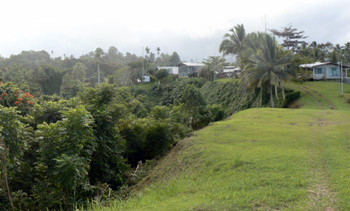 |
| The POC campus is located 1,200 feet above sea level in Nobnob in the province of Madang. |
After eight weeks in Nobnob, we enter the second phase of the course, which is village living. During this time, our family will live in a village for five weeks without any other foreigners. This will allow us to practice Tok Pisin and apply what we have learned during the first eight weeks of the course so that we can understand what village living is really like.
After the village living phase, we will return to Nobnob for one week to reflect on our experiences with the other trainees. Then we will move to Ukarumpa, which is about seven miles from Kainantu in the Eastern Highlands Province. This is the translation center where we will be located until we are assigned to work on a language project. Please keep us in your prayers!
Are The Kids In School?
Yes! The elementary program at POC consists of devotional times, Tok Pisin language learning, journaling, Papua New Guinea culture, math, spelling, and reading. The program is designed to help kids adjust, feel comfortable, and make friends with the national children as well as to make them feel like they are a real part of our family’s ministry. Younger kids are placed in childcare, which is staffed by several experienced Papua New Guinea women, who help the younger kids adjust to the new language and culture.
What Is Tok Pisin?
The national language of Papua New Guinea is Tok Pisin (Talk Pidgin). A pidgin is a simplified language that develops as a means of communication between two or more groups that do not have a common language. Because Papua New Guinea has over eight hundred spoken languages, people use Tok Pisin to talk with people from other language groups. The majority of people in Papua New Guinea speak Tok Pisin as a second language. Because pidgin languages have limited vocabulary, they often have long-winded ways of saying things. For example, if you wanted to say ‘piano’, you would say, “bigpela bokis sapos yu paitim long maus i kraiaut,” which basically means “a big box that if you hit it on the mouth it makes noise.” Or you would say ‘messiah’ like this, “dispela man God i salim bilong kisim bek ol manmeri bilong en,” which basically means, “this man that God sent to take back all people that belong to him.” The good news is that most of the vocabulary of Tok Pisin is borrowed from English, which will make it easier for us to learn.
What Are Your Living Conditions?
During the Nobnob phase of POC, we are staying in dorms that have electricity and running water (although we are taking bucket showers). All of the trainees eat together in a dining hall. During the village living phase of POC, we will not have electricity or running water. During that time, we will live with a wasfamili (host family), who will help us learn how to prepare our own food by cooking over an open fire. Common foods include sago, taro, sweet potatoes, pineapples, mangos, passion fruit, bananas, pig, and fish.
Sunday, January 1, 2012
You Are Coming With Us

Open House to Say Goodbye
We wish we could visit everyone one more time to say goodbye. But with just a couple of weeks to go before we leave on January 20, we know that is impossible. So we would like to invite you to stop by our house to say goodbye. We will have an open house on Monday, January 16 and Tuesday, January 17 from 5 to 8 p.m. If you are able to come by, we would welcome the chance to see you one more time and say goodbye. You don't need to RSVP, and please do not bring any gifts or food (we will not be able to bring anything else with us). Our house is located at 218 E Puente St in Covina. We hope to see you then!
Prayer Requests
Prayer Requests
Please pray for our travel to Papua New Guinea. Pray that we and our baggage will make all of our connections without delay, that we will not have any excess baggage fees, that the cargo we are shipping via boat will arrive without any problems or excessive customs fees, and that God will pour out an extra measure of grace and patience upon the whole family during our extremely long trip. Please also pray for health and stamina during our 14-week orientation that begins three days after we arrive in Papua New Guinea. God answers your prayers, so thank you for praying.
2011 Boyd Family Video
2011 Boyd Family Video
Each year, we create a video to commemorate some of the highlights from our past year as a family. You can watch the 2011 Boyd Family Video below.
Thursday, December 1, 2011
50 Days to Go
With just fifty days to go before our departure for Papua New Guinea on January 20, our feelings of excitement and anticipation are growing day by day. And as we enter the Christmas season, we almost feel like kids waiting for that magical day to come when we embark on the next phase of our journey. But unlike kids waiting to see what they will get on Christmas morning, we are chomping at the bit to see what God will enable us to give when we finally arrive in Papua New Guinea. Jesus said, "It is more blessed to give than to receive" (Acts 20:35), and we feel extremely blessed to be able to give of ourselves so that others can have access to the Word of God in a language they really understand.
An Unforgettable Evening
A couple months ago our pastor asked us to be a part of Covina Assembly's annual missions banquet on Sunday night, November 13. He said that we should just be prepared to share for fifteen minutes about our preprations over the past year. We always try our best to be well prepared when asked to speak at a church, but nothing could have prepared us for the incredible service we had that night. The church dedicated the entire evening to blessing, honoring, and commissioning us for our work in Papua New Guinea. The church invited Martha's dad and aunt as well as Adam's cousin. And then they pulled out the ultimate surprise by bringing out Adam's parents, sister, and niece, whom they had flown in from Pittsburgh and Seattle. People shared testimonies in person, via video, and even through a live Skype call to let us know how we have made a difference in their lives. The church then showered us with gifts to make our life a little more enjoyable in Papua New Guinea (including some things to keep the kids happy on the 28-hour trip to get there). We were completely amazed and overwhelmed. The church couldn't have made us feel more loved, appreciated, and supported. It was a night we will never forget.
Un Mensaje en Español
Adam had the opportunity to share for ten minutes in Spanish at two services in November. Adam had studied Spanish in high school and college and had the opportunity to learn a lot during our year in Ecuador. He is not completely fluent, but with a lot of practice and the help of our friends Gustavo Arias and Erica Gomez, it seemed to go over well. Click play below to hear Adam share our story in Spanish
The Nativity
Two years ago, we decided to have some fun and make a short film called The Nativity with Bella as Mary, Jacob as Joseph, and Asher as the baby Jesus. We thought we would share it with all of you as a way to say Merry Christmas! Watch it below.
An Unforgettable Evening
A couple months ago our pastor asked us to be a part of Covina Assembly's annual missions banquet on Sunday night, November 13. He said that we should just be prepared to share for fifteen minutes about our preprations over the past year. We always try our best to be well prepared when asked to speak at a church, but nothing could have prepared us for the incredible service we had that night. The church dedicated the entire evening to blessing, honoring, and commissioning us for our work in Papua New Guinea. The church invited Martha's dad and aunt as well as Adam's cousin. And then they pulled out the ultimate surprise by bringing out Adam's parents, sister, and niece, whom they had flown in from Pittsburgh and Seattle. People shared testimonies in person, via video, and even through a live Skype call to let us know how we have made a difference in their lives. The church then showered us with gifts to make our life a little more enjoyable in Papua New Guinea (including some things to keep the kids happy on the 28-hour trip to get there). We were completely amazed and overwhelmed. The church couldn't have made us feel more loved, appreciated, and supported. It was a night we will never forget.
Un Mensaje en Español
Adam had the opportunity to share for ten minutes in Spanish at two services in November. Adam had studied Spanish in high school and college and had the opportunity to learn a lot during our year in Ecuador. He is not completely fluent, but with a lot of practice and the help of our friends Gustavo Arias and Erica Gomez, it seemed to go over well. Click play below to hear Adam share our story in Spanish
The Nativity
Two years ago, we decided to have some fun and make a short film called The Nativity with Bella as Mary, Jacob as Joseph, and Asher as the baby Jesus. We thought we would share it with all of you as a way to say Merry Christmas! Watch it below.
Subscribe to:
Posts (Atom)